

Piacenza Cathedral or Duomo

The first stop is Piacenza, with its Cathedral. An important example of Romanesque architecture in Italy, built between 1122 and 1233, it is dedicated to Santa Maria Assunta and the city’s co-patron saint. Inside, you will find the Kronos Museum, which also offers the option of a separate climb to the dome.
This ascent follows mediaeval passageways carved into the thickness of the walls: 134 steps lead to the destination, via spiral staircases and attic spaces. Between each stop, there are continuous views of both the city and the interior of the church.
The final destination is the masterpiece that can be admired up close, started by Pier Francesco Mazzucchelli (‘Il Morazzone’) and completed, most notably, by Giovanni Francesco Barbieri (‘Il Guercino’) between 1626 and 1627. After Mazzucchelli’s death, Barbieri took over, painting the lunettes depicting the prophets Haggai, Hosea, Zechariah, Ezekiel, Micah and Jeremiah, scenes from the life of the infant Jesus, eight fascinating Sibyls, and the frieze of the drum.
Telephone 3314606435
cattedralepiacenza@gmail.com
https://www.parcoculturale.it/parco-culturale/chiese/salita-al-guercino.html
Basilica of St Mary Campagna

The Basilica of St Mary Campagna in Piacenza is a true Renaissance gem, perfectly integrated into the setting of the historic centre. The dome is adorned with an important cycle of frescoes by Giovanni Antonio Sacchi, known as Il Pordenone, who worked on them from 1530 to 1535.
The tour takes in Pordenone's other works, namely the painting dedicated to St Augustine, followed by the chapels depicting the stories of the Magi and St Catherine, before reaching the complex iconographic programme of the dome, which depicts themes from the Old and New Testaments, such as God the Father descending from heaven in flight, in the central lantern.
Telephone: 349 516 9093
salitapordenone@gmail.com
www.salitaalpordenone.it
It is also possible to book a visit to both the Guercino and Pordenone domes with a single ticket.
www.mirabiliprospettive.it
+39 349 516 9093
prenotazioni@mirabiliprospettive.it
Baptistery of Parma
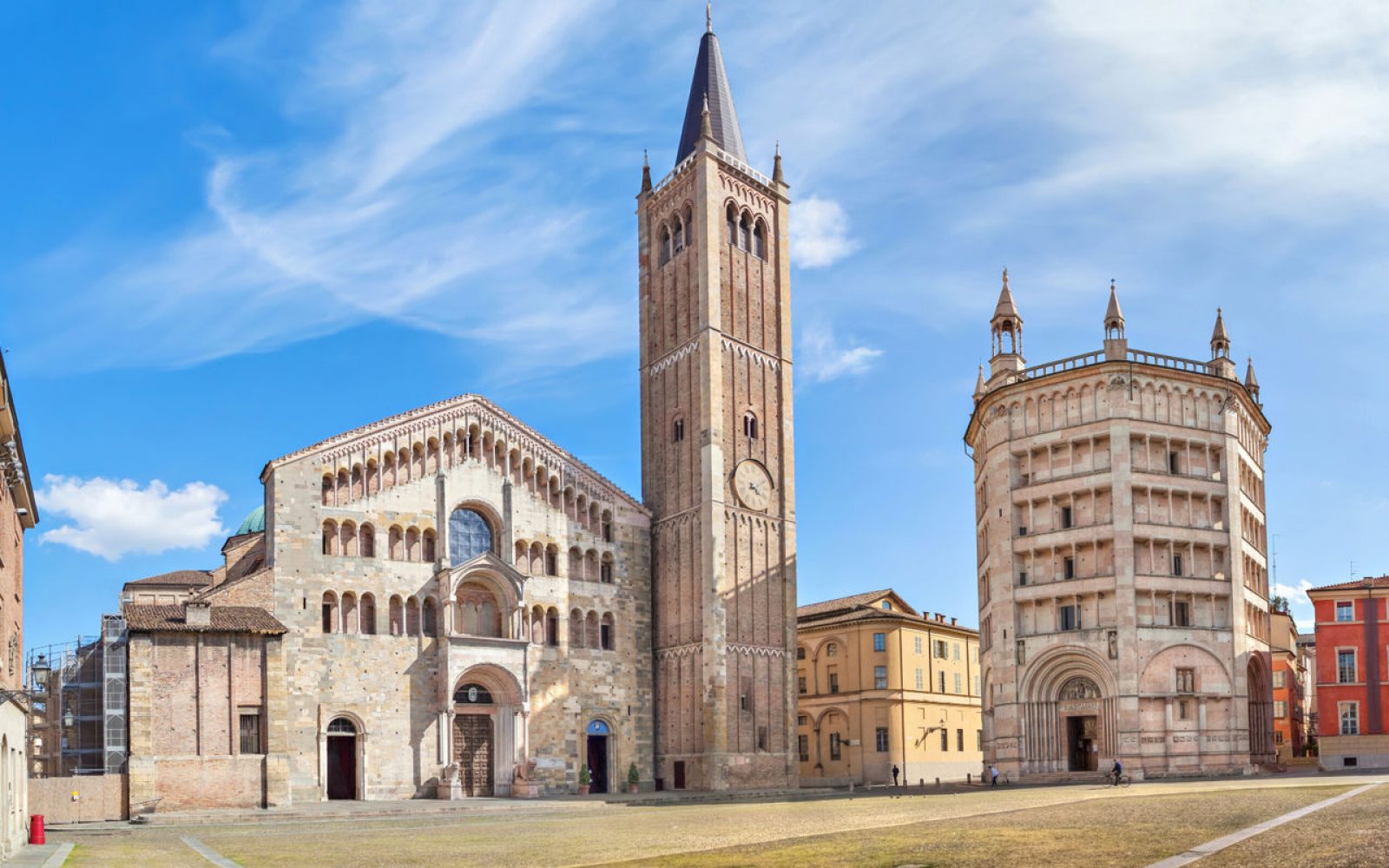
On the second day, we move on to Parma, and more specifically to its Baptistery, one of the most significant monuments of the transition from Romanesque to early Gothic architecture. Here, you can admire a dome divided into 16 segments and painted in tempera by artists from the Po Valley, influenced by Byzantine iconographic models.
To view the three domes frescoed by Antonio Allegri, known as Correggio, you can start from the nearby Room of San Paolo, in the private apartments of Giovanna da Piacenza, Abbess of the Benedictine Monastery of San Paolo. With its original umbrella vault, this room is one of the greatest masterpieces of the Italian Renaissance and the first of the domes painted in Parma by Correggio, in chronological order.
Here, in 1519, the painter employed an innovative and original painting style that suggests familiarity with Mantegna's work in Mantua, featuring a pergola from which cherubs and allegorical figures look out.
The Room of San Paolo
Via Melloni, 3
+39 0521218215
cameradisanpaolo@comune.parma.it
Basilica of St John the Evangelist

In Parma, the dome of the Basilica of St John the Evangelist was frescoed by Correggio between approximately 1520 and 1524. The monastic complex includes the Convent, three magnificent cloisters, the monumental Library and the Historic Pharmacy of San Giovanni. The dome depicts the Vision of St John. Correggio depicts Christ surrounded by 11 apostles, with the aged John at the bottom, who sees the heavens open wide and Christ appear, indicating his place within the circle.
Parma Cathedral

The frescoed dome of Parma Cathedral, dedicated to the Assumption of the Virgin, is the third dome painted by Correggio in chronological order and dates from 1524–1530. It is located above the high altar, and the Virgin is positioned so that she can be seen by worshippers from the central nave. Correggio’s pictorial language, highly innovative for its time, anticipated the Baroque era through its bold perspectives and foreshortened views featuring cherubs, saints and clouds that, in a whirlwind, break through the wall, creating the illusion of an open sky.
Basilica of the Blessed Virgin of Ghiara


In Reggio Emilia, we visit the Basilica of the Beata Vergine della Ghiara, the construction of which began in 1597 thanks to offerings from the faithful following a miracle in which the young Marchino regained his hearing, his tongue grew, and he was granted the ability to speak and to know the names of all things. This miracle occurred after prayers were offered to the image of the Virgin, painted in fresco by the Reggio-based artist Giovanni Bianchi, known as Bertone, based on a drawing by Lelio Orsi (preserved in the Ghiara Museum) and housed in a small chapel built in the friars’ garden.
Shortly after the miracle was officially recognised, the municipality decided to protect the image by building the new church. The solemn consecration ceremony, attended by a huge crowd of worshippers and the ducal court, took place on 12 May 1619.
La Ghiara became the most fashionable construction site not only in the city, but throughout the entire region, where the most popular painters competed to create the frescoes and altarpieces, notably Leonello Spada and Alessandro Tiarini from Bologna, but also Carlo Bononi, Camillo Gavassetti, Ludovico Carracci and Francesco Barbieri, known as Il Guercino. A visit to the Sanctuary of the Ghiara is therefore like a visit to a rich art gallery of Emilian art from the first half of the 17th century, with the key difference that the paintings can still be seen in the place and position for which they were intended.
The dome was erected by Francesco Pacchiani to a design by Cosimo Paglioni and was frescoed in the 17th century by Lionello Spada, a pupil of the Carracci brothers, who drew inspiration from the Old Testament and demonstrated all his skill in the art of perspective.
The municipality commissioned Guercino to produce a work that is considered his masterpiece: the altarpiece 'Crocefissione di Cristo, con ai piedi la Madonna e i Santi Maria Maddalena, San Giovanni e San Prospero' ('Crucifixion of Christ, with the Virgin Mary and Saints Mary Magdalene, John and Prosper at His Feet'), created between 1624 and 1625.
BASILICA DELLA GHIARA
https://www.basilicaghiara.it/
fabbricerialaica@basilicaghiara.it
Corso Giuseppe Garibaldi, 44 – 42121 Reggio Emilia


