


Marina Corricella
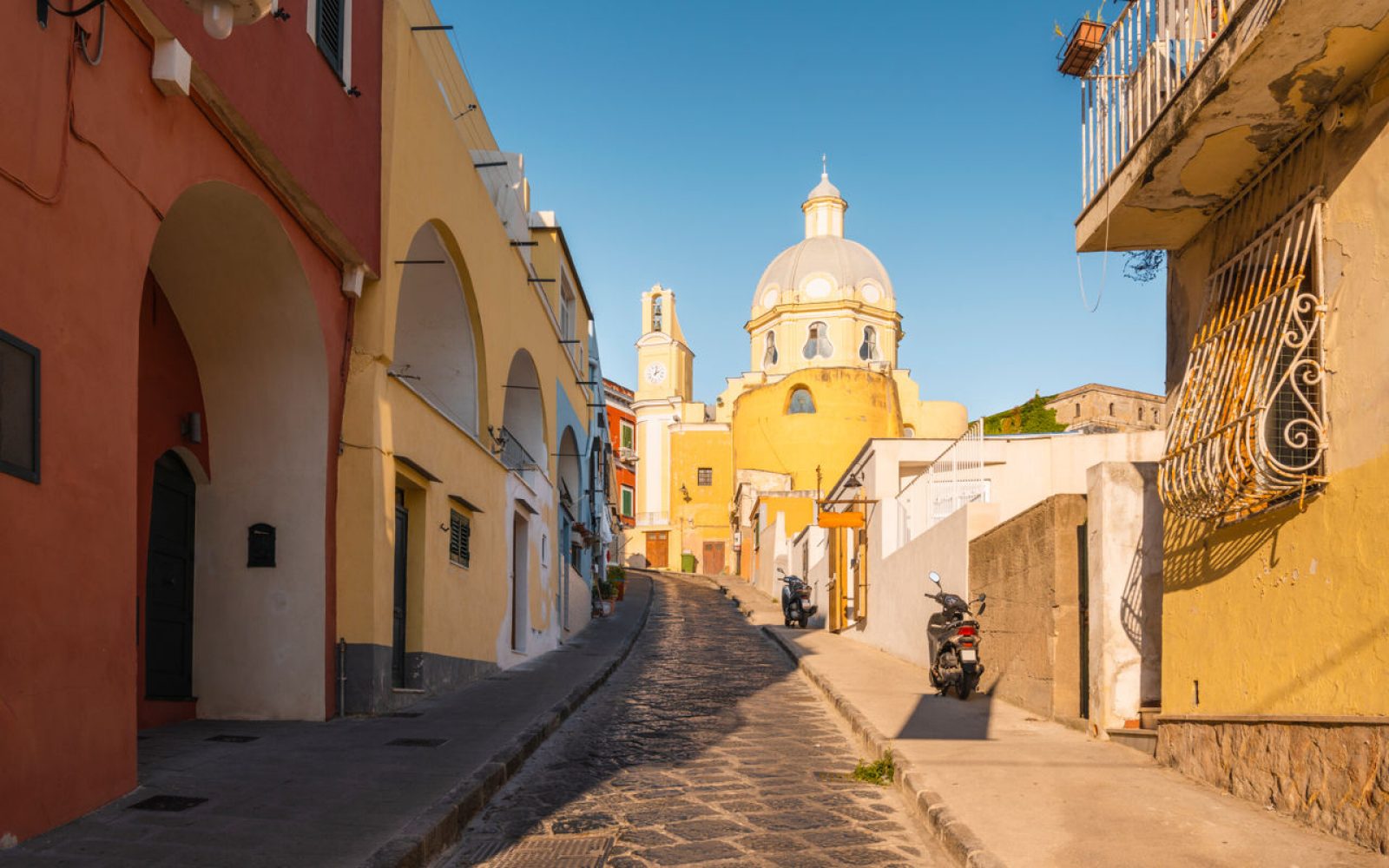
The protagonist of Il Postino is Mario Ruoppolo (Massimo Troisi), an unemployed young man who is unable to get on a boat without immediately feeling ill. He is naturally unsuited to life on a tiny island off the coast of Campania, where the main source of income (including that of his parents) is fishing. The island is never named in the film, but the real-life location is Procida, which together with Ischia, Vivara and Nisida forms the Phlegraean archipelago.
The seaside village where the events of the film take place is Marina Corricella (also known simply as Corricella), in the oldest inhabited settlement on the island. It is a picturesque example of “spontaneous architecture”: a curious mosaic of colourful houses overlooking the sea and arranged in an amphitheatre, where it is impossible to understand where one house ends and another begins.
43 Via Marina Corricella, facing the boats and fishermen’s nets, among the tables and parasols, you’ll immediately recognise the distinctive architecture of the inn where Beatrice (Maria Grazia Cucinotta) works, with whom Mario Ruoppolo falls in love during a game of table football. The tavern is still in business and in honour of the film it bears the name “Locanda del Postino”.
From the square in front of the tavern, climb the steps of the Discesa Graziella, turn right and you’ll be on Via San Rocco, the road that the protagonist struggles to climb on his bicycle (this road also appears in Anthony Minghella’s film “The Talented Mr. Ripley”).
At the end of the road, you’ll reach the Sanctuary of Santa Maria delle Grazie, the church that appears in the scene depicting the procession of the Madonna, which ends at the seashore. This building overlooks Piazza dei Martiri, where at number 8 there is a tobacconist’s shop which in the film is the post office: here Mario finds work as Pablo Neruda’s (Philippe Noiret) personal postman. This street, like Via San Rocco, also appears in Minghella’s film, but instead of a post office it is home to the shop of Silvana, played by Stefania Rocca in the film.
Just around the corner, as you enter Via Principessa Margherita, is what in the film is the entrance to the cinema, the place where Mario learns that Neruda is coming to the island as a political refugee.
Before leaving Corricella and reaching the next stop, we recommend continuing from Piazza dei Martiri up Salita Castello to the small medieval village of Terra Murata. A visit to the fortified village is a must before leaving Procida, both to admire its historical treasures such as Palazzo d’Avalos and the Abbey of San Michele, and to enjoy a breathtaking view of Corricella and the Gulf of Naples.
Cala di Pozzo Vecchio
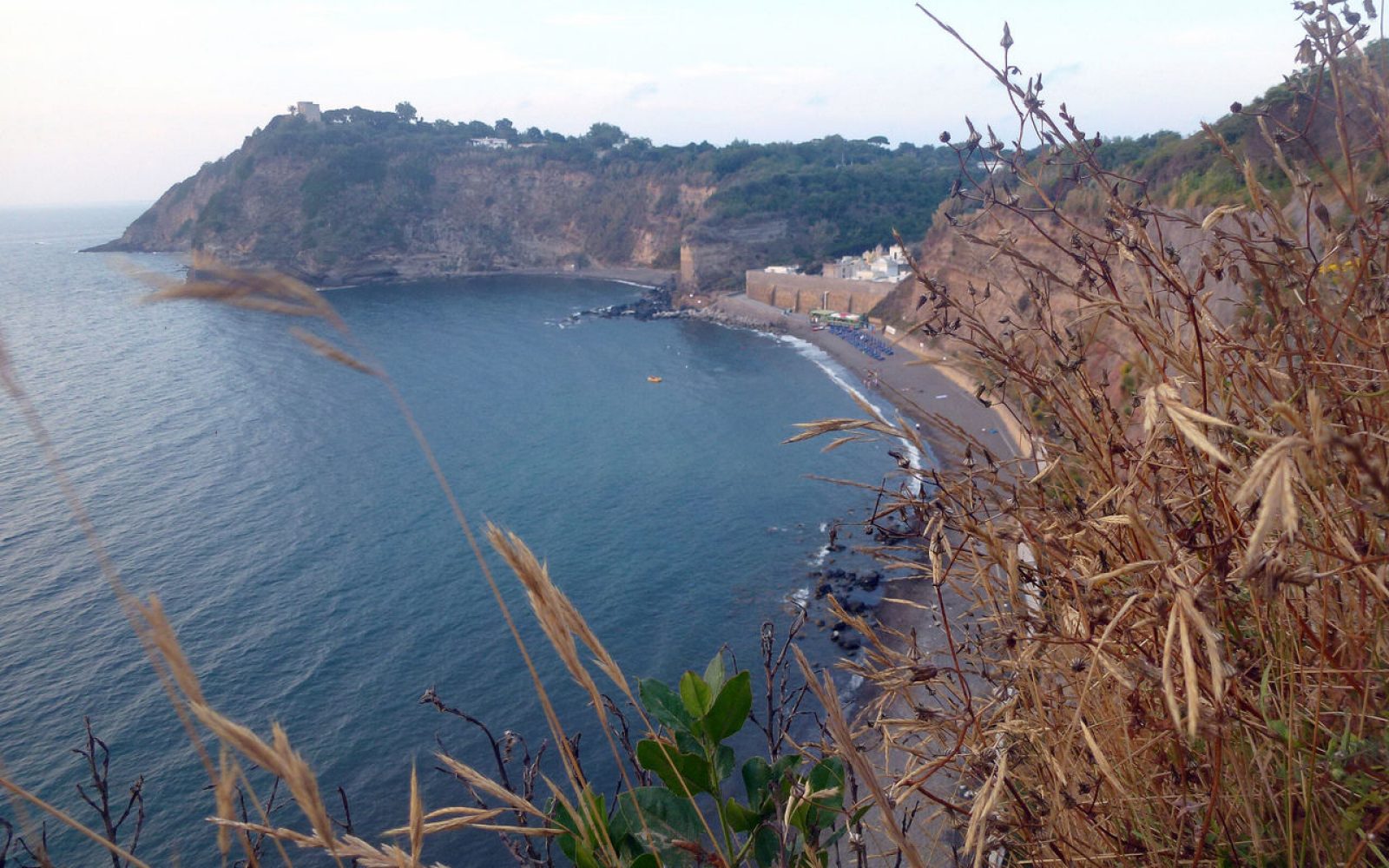
After taking on the role of Pablo Neruda’s personal postman, Mario develops a deep friendship with the Chilean poet. Thanks to Neruda’s influence and advice, Mario manages to cultivate his poetic side and finds a way to win Beatrice’s heart. The young postman dedicates verses to his sweetheart during clandestine meetings, which take place on one of Procida’s beautiful beaches.
The beach later dubbed “La Spiaggia del Postino”, where the romantic rendezvous took place, is Cala di Pozzo Vecchio, in the west of the island. You can reach it from Corricella in less than 10 minutes by car or on foot in about 30 minutes along Via Marcello Scotti, before turning onto Via SS. Annunziata and continuing until you reach the municipal cemetery of Procida. From the cemetery entrance, take the small road on the right: it leads to a bay, which winds its way between Punta Serra (to the south) and Punta Ottimo (to the north), bordered by sand and rocks. There, you can relive some of the most moving scenes in Troisi and Radford’s film. You’ll be pleased to hear that the beach is free and part of it has facilities.
This concludes the Campania part of the itinerary. To continue following in the footsteps of Il Postino, you’ll need to head to sunny Sicily, setting sail for the Aeolian Islands, which provided the film with its unforgettable natural landscapes.
Pollara

Just as Procida, with its enchanting village of Corricella, was the ideal location for the village in Il Postino, Salina, with its volcanic hills and cliffs, was a truly inspired choice for depicting the surrounding countryside. It is this fascinating Aeolian landscape that accompanies Mario on his bike rides from the village to Pablo Neruda’s house.
Filming took place in Pollara, in the western part of the island. From here, looking towards the sea, you can make out the iconic Scoglio Faraglione that forms the backdrop to the conversations between Mario and Pablo Neruda and, further away, the island of Filicudi.
Pollara is a small hamlet in the municipality of Malfa, nestled in a volcanic caldera overlooking the sea.
From the village of Pollara, walk north along Via Chiesa until you reach the small Church of Sant’Onofrio. In the courtyard, you’ll immediately notice the mural dedicated to Massimo Troisi and Philippe Noiret (Pablo Neruda in the film), depicted sitting a short distance from each other.
Continue along the road with the church on your left and, when you reach the cemetery, turn onto the scenic road that Mario Ruoppolo travelled along to reach Pablo Neruda’s house, named Via Massimo Troisi in honour of the protagonist’s immortal talent. After a few minutes, you’ll come to a statue dedicated to the postman, an unmistakable figure on his bicycle looking out to sea, as in an iconic scene from the film. Leaving the statue behind, continue along Via Troisi and you’ll reach the Casa di Neruda, which in the film is the house where the poet is given political asylum. Immersed in the colours and scents of the maquis, the private residence is a pilgrimage destination for film buffs from all over the world and is a typical example of Aeolian architecture. It appears in the film after being renovated using traditional local materials and techniques. From here, continue northwards and you’ll soon reach the next stop, Mario’s House.
Mario’s house on Pollara beach

Continuing along Via Massimo Troisi, you’ll soon reach a panoramic lookout, from which the road continues in a winding, stepped descent towards the small bay of Pollara. Like the previous beach, Cala di Pozzo Vecchio, this little beach has also been renamed “La Spiaggia del Postino”.
At the end of the descent, you’ll come to a group of small stone structures set on the rocks. Once you’ve descended the last flight of steps, with your back to the sea, you’ll be facing what in the film is the home of Mario and his father. In reality, the buildings are not actually houses, but old coastal warehouses used by fishermen, known as “balate”, typical of Aeolian architecture. From the same spot, looking to your right, you’ll recognise the beach where Mario and Pablo Neruda had long conversations. Unfortunately, the beach no longer exists due to erosion, but the outline of the rocky ridge that bordered it is immediately recognisable.
Against this backdrop, Philippe Noiret walks alone in the poignant finale of the film, in which a nostalgic Neruda tries to soothe his sadness by immersing himself in the beauty of the natural surroundings.
Before leaving Salina, enjoy the view of the Pollara caldera and the sea by taking the SP183 road up to the viewpoint of Castello or Semaforo di Pollara, an old Italian Navy watchtower. The area is located at the foot of Monte dei Porri, one of the six volcanoes that formed the island and the second highest peak in Salina, part of the Le Montagne delle Felci e dei Porri Nature Reserve.
The itinerary through the locations featured in Il Postino ends here, but in the words of Mario Ruoppolo: “Poetry doesn’t belong to those who write it; it belongs to those who need it.” So let the poetry of these places be a constant companion, inspiring you and filling your journey with beauty.







