
Home » Italien entdecken » Piemont » Cuneo

Cuneo - Via Roma, arcades
The province of Cuneo extends to the south-western tip of Piedmont and borders France to the west and Liguria to the south.
The Alps, with the Monviso massif and the hills of Langhe, Roero and Monferrato cover most of the territory, while at the centre there is a vast plain traversed by Po, Tanaro and other rivers. The beautiful landscapes offer great variety: valleys with luxuriant vegetation, hills with patchworks of vineyards broken up only by castles, and wildlife reserves of unique beauty.
The Parco Naturale delle Alpi Marittime (natural park) features high altitude lakes that reflect the surrounding peaks with unforgettable views. The Parco Fluviale Gesso-Stura and the Parco Fluviale del Po Tratto Cuneese are of equal beauty and encompass unique landmarks, such as the rio Martino cave with a spectacular waterfall.
In addition to its natural beauty, the area offers many other attractions. Its positions made it an important point of contact between peoples and cultures. The most important routes of medieval pilgrimage ran across it: the Way of San Giacomo and Via Francigena. Important families fought for control down the ages. Its artistic and cultural heritage bears witness to centuries of history: castles and towers, that have become an integral part of the landscape, villas and princely residences, and wonderful abbeys, such as the Staffarda abbey.
In the territory around Cuneo, there are various towns with a wealth of history and artistic works, such as Alba, Fossano, Mondovì and Saluzzo, one of the most fascinating towns in Piedmont. The area is also home of the best Italian wines, and has been enriched by Occitan cultural influences, religious, gastronomic and folkloristic traditions, that make it the perfect spot holidays steeped in culture and enjoyment.
The first step on an exploration of this area should be Cuneo, surrounded by the snow-covered peaks of the Alps and is dominated by the Torre Civica .
Piazza Galimberti, a wide and central square, is the point of departure for a visit to Cuneo Vecchia with its arcades, lanes and monuments: the cathedral, the former church of San Francesco and the Museo Civico.
A land of traditions and culture, it boasts many residences of the Savoy, of immense architectural importance and are surrounded by wonderful parks and listed by UNESCO as World Heritage Sites: the royal castle of Racconigi, an imposing building featuring different styles, the castle of Pollenzo in the municipality of Bra, the castle of Govone which boasts rich décor and fine wooden furniture, and finally, the Savoy residence of Valcasotto in the municipality of Garessio. Archaeological sites dating back to the Roman era are definitely worth a visit, including the Excavation of Augusta Bagiennorum and the ruins of ancient Pollentia with the remains of the theatre and of the amphitheatre.
Along the ancient medieval pilgrimage routes, the Via Francigena and the Way of Santiago, there are many artistic and religious relics. The most famous are: the shrines of San Magno in Grana Valley, of Sant’Anna di Vinadio and of the Madonna dei boschi in Boves.
Sites of great spiritual importance lie in the territory, such as the imposing abbey of Staffarda, one of the most important medieval monuments of Piedmont, and the monastery of Pesio which lies in a picturesque valley.
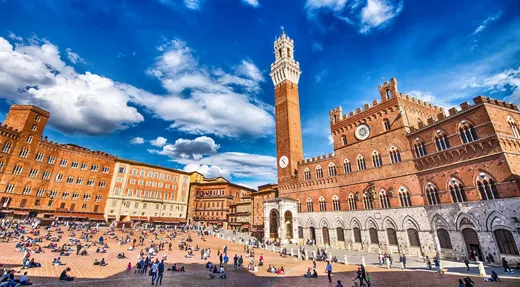
Saluzzo is known as the “Siena of Piedmont” and offers an interesting visit to admire monuments dating back to the Middle Ages and the Renaissance, testaments to its role as the capital of an important marquisate.
Other important sites are Alba, the medieval “town with a hundred towers” that lies in the River Tanaro Valley, the home of the precious white truffle; Bra, renowned for the production of carnival masks, and Dronero, a summer resort boasting fine examples of architecture.
An interesting route through the hills reveals ancient manors like the castle of Cavour in Grinzane, one of the most evocative buildings of the Langhe where Camillo Benso used to live; the castles of Cherasco, Manta and Acaja di Fossano, with an ancient drawbridge that still functions. Piasco is the home of the Museo dell’arpa Victor Salvi with it’s a fascinating collection of harps.
From Franosa Soprana to Limone Piemonte, from Vinadio to Argentera and Pontechianale, the mountains and valleys offer winter sports, in modern resorts fully equipped with facilities and pistes for skiing, cross country skiing and snowboarding, along with snowshoe and skating trails.
There are many mountaineering and trekking trails for all degrees of difficulty right up to the Grande Traversata delle Alpi, which is a regional itinerary through specific paths and with the option of staying in a series of lodges.
The Parco Naturale delle Alpi Marittime (natural park) provides many hiking trails, while the Parco Fluviale Gesso-Stura offers a wide range of walking/biking trails and the city of Cuneo boasts many swimming pools and sport facilities.
Valdieri, Vinadio, Garessio, Roccolo di Busta, Camorei di Borgo San Dalmazzo, Lurisia, Peveragno are thermal springs with health centres that offer rejuvenating and relaxing stays.
There are many events and festivals during the year, such as the National Exhibition of craftsmanship and antiques of Saluzzo, or the Inernational Fair of white truffles of Alba, or the traditional Palio degli asini, a donkey race in Alba.
The historical reenactments are especially evocative, such as the Bahio di Sampeyre commemorating the victory of the inhabitants of Cuneo’s valleys against the Saracens during the Middle age; the Roumiage de Setembre in Coumboscuro, and the Giostra dell’oca, a tournament staged in Fossano with archers, infantrymen and flag-bearer processions.
The most important product is the white truffle of Alba that has an intense fragrance and is picked in various areas: Langhe, Monferrato, Roero. Just as tasty and appreciated, the black truffle is gathered in the Mongia and Grana valleys.
The most common main courses are dunderet di patate, tajerin, agnolotti, gnocchi alla bava and risotto with quails. The cheeses include various kinds of toma from the Langhe, the robiola of Dogliani and bruss. Castelmagno cheese is a renowned local product made in the Occitan valleys of Piedmont, where the ancient Oc language is still spoken.
The most outstanding typical products are cured meats such as “batiur” or “mariur”, made from pork, spices and wine; and cured beef.
The local desserts include cuneesi with rum and the torrone d’Alba, a type of nougat. In the Monviso valleys, losëtte, brut e bun ("ugly but tasty") with almonds and hazelnut granola, and risòle (fried ravioli with jam inside and sugar topping), are the best known. In the Po Valley, a typical sweet is batiaje, pastries made with yellow flour.
From Langhe to Monferrato and Roero, this is a realm of great wines like Barolo, Barbaresco, Dolcetto, Nebbiolo, Freisa and DOC wines of the Saluzzesi Hills.
Das in den sanften Hügeln der Marken versunkene Fermo ist einer der wichtigsten Orte der Region. Die typisch mittelalterliche Altstadt lädt Besucher zu einem Stadtbummel durch die malerischen Gassen ein, um die gastfreundliche und familiäre Atmosphäre zu erleben. Die Gassen ...
Eingeschlossen zwischen dem Po und dem Apennin erstreckt sich die Provinz Piacenza am westlichen Ende der Emilia-Romagna. Ihr Gebiet umfasst die herrlichen Täler der Flüsse Tidone, Trebbia, Nure und Arda, von denen sich jedes durch eine besondere Landschaft auszeichnet. Hier herrscht ...
Die im mittleren bis östlichen Friaul gelegene Provinz Udine grenzt im Norden an Österreich, im Osten an Slowenien und im Süden an die Adria. Die abwechslungsreiche Landschaft erstreckt sich von dem beeindruckenden Strand von Lignano Sabbiadoro, einem international beliebten Urlaubsziel ...
Die Provinz Asti befindet sich im Herzen des Piemont und grenzt im Süden an Ligurien. Das vorwiegend hügelige Gebiet erstreckt sich über Monferrato und einen kleinen Teil der Langhe, die Langa Astigiana; durch das Zentrum der Provinz fließt der Tanaro. Durch die Abfolge sanfter ...
Italien, das Land der Berge Immense Täler mitten im Grünen, faszinierende Gipfel zwischen den Wolken am blauen Himmel, saubere Gewässer – das alles macht die italienische Gebirgswelt aus, die zu jeder Saison eine perfekte Urlaubskulisse abgibt. Viele Fremdenverkehrszentren sind Orte, an ...
Im Frühling bekommt man Lust auf Schlösser und Burgen. Hier sind wir keineswegs an der Loire, sondern in der Provinz von Cuneo. Das Schloss Racconigi gehörte zuerst den Grafen von Sabuzzo und Fossano, bevor es in den Besitz der Savoyer überging. Es wurde zu einer neoklassischen Residenz ...
Es heißt, die Einwohner Albas seien große Glücksspieler und gleichzeitig unermüdliche Arbeiter in ihren Läden und Werkstätten. Der weiße Trüffel ist das Symbol für ihre Veranlagung zur Herausforderung. Bevor der Trüffel zur Attraktion des Gebietes sowie zu einem der wertvollsten Produkte ...
Es ist erstaunlich, wie die Langhe, ein schmaler Abschnitt des Piemonts zwischen Asti und Cuneo, in 50 Jahren ihr Erscheinungsbild verändert haben. Vormals war es ein armes Gebiet, das durch das harte Leben auf den Feldern gekennzeichnet war. Heute ist es ein wohlhabendes Land, wo Schlösser und ...
The splendid walk known as Giro del Ponte passes the wooded valley of the River Tessino, crossed on high by the Ponte delle Torri, an imposing structure with ten arches dating from the fourteenth century. The walk across the bridge is spectacular: it dominates the green valley defended by the ...
We are on a quite path near Alba, in the centre of the Langhe. All around us is a breath-taking view. Small villages are linked by winding roads that mark the crests of hills completely covered in vineyards and woods. In the hazelnut, oak and chestnut woods grow the internationally famous truffles.
Here we are in Barolo, the town that gave its name to the renowned wine; we are standing before the imposing Castello Falletti. The cellars of the castle host the Enoteca Regionale del Barolo, the 'king of wines'. Descending by a narrow flagged road we can admire the dense woodlands that surround ...
Turin is the 'county town' of Piedmont, the region whose name means 'land at the foot of the mountains', where the mountains are the splendid Alps. Monviso, with its 3841 metres in height dominates the Piedmontese plains and is known as the 'Stone King'. The River Po, which runs through Turin, is ...